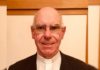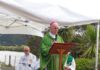

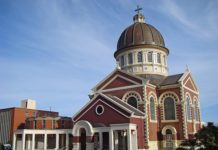


ROME (CNS) The March 14 inauguration of the first Catholic church built in predominantly Muslim Qatar "is a sign of great hope for the Church" in the region, said the new church’s pastor. Capuchin Father Tomasito Veneracion, the new parish priest of Our Lady of the Rosary Church, told Aid to the Church in Need that the construction and opening of the new church was a "historic event."
Aid to the Church in Need, a Catholic organization funding religious projects worldwide, including the construction of the church in Qatar, published the Philippine priest’s remarks in a March 12 press release.
For decades, Christians in Qatar had to practice their faith in cramped garages, private homes and, most recently, in foreign schools and prefabricated halls.
In April 2003 the government of this tiny Persian Gulf nation overwhelmingly approved a new constitution that guaranteed freedom of expression, religion, assembly and association. That meant local mission parishes went from being underground, but tolerated, to legally recognized.
Soon after, the country’s emir, Sheik Hamad bin Khalifa al-Thani, donated a large tract of land in the suburbs of Doha for the building of churches for the Catholic, Anglican and Orthodox communities.
Bishop Paul Hinder, apostolic vicar of Arabia and Yemen, told Vatican Radio March 13 that the minority Catholic population living in Qatar was overjoyed about finally having a permanent church.
The official consecration of the church was anxiously awaited by the faithful there since they had long hoped to "have a place to hold ceremonies and gather together safely and in dignity," he said.
For the Catholics, all immigrants, "it is like finding a home, a homeland on foreign soil," Bishop Hinder said.
At least 75 percent of Qatar’s almost 600,000 inhabitants are foreign. Ten percent of the population is Christian, and all of them are from abroad.
They come from India, Sri Lanka, the Philippines, Indonesia, Korea, Jordan, Syria, Egypt, the United States, Central Africa and Eastern and Western Europe. Almost all the large numbers of foreigners work in service and tourism or the country’s booming natural gas and oil industries.
Qatar and the Vatican established full diplomatic ties in 2002.
When asked how the local Muslim population has reacted to the construction of the church, Bishop Hinder said, "There’s always someone who is not in agreement, who finds that the country may have been too generous.
"But I have the impression that the majority of people, even the locals, understands (why) in principle and agrees that the people who came to this country, who work for the good of the country, must also have the possibility to exercise their faith in a dignified manner," the bishop said.
Some restrictions are still in place: Christian symbols must not be publicly displayed. Our Lady of the Rosary Church will have no exterior cross or bell tower, and only Catholics will be allowed inside, said the press release from Aid to the Church in Need.
"However, indoors we are free to do everything that is part of a church," Bishop Hinder said.
He said he thought further progress in religious freedom would go hand in hand with increased development in the region, which would lessen some of the social or economic "anxieties, pressures," that prevent leaders from moving ahead with greater reforms.
He said political concerns like the unresolved conflict in the Holy Land, the plight of the Palestinians and the Iraq War "also have a direct or indirect influence on the issue of religious freedom" in the Middle East.