





by NEVIL GIBSON
“In politics, if you want anything said,” Margaret Thatcher once famously observed, “ask a man. If you want anything done, ask a woman.”
She was dedicated to making a difference and not wanting to die having just washed teacups all her life. But, unlike Superwoman, her film biography is bookended by scenes of an ailing, vulnerable old lady given to memory loss and hallucinations.
At first this appears cruel and unnecessary; old age is no crime and comes to most people.
By initially showing her at the furthest extreme from her public persona as one of the 20th century’s greatest politicians, The Iron Lady (Icon) is asking a lot of the audience’s sympathy.
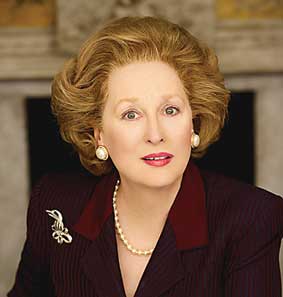
However, any fears are soon dispelled by Meryl Streep’s bravura performance in which she plays a frail, stooped woman in her 80s as well as the blossoming politician in her 30s through to her heyday as Britain’s prime minister.
The role demands as much, if not more, as Colin Firth’s in The King’s Speech and will as surely mean yet another Oscar for Streep.
It is also no coincidence that The Iron Lady will appeal to the same audience as The King’s Speech, which was one of this year’s most popular releases.
Gradually, through a series of flashbacks prompted by mementoes around her apartment and nightly appearances by her late husband, we get to see more of the Thatcher we know.
Some of this is familiar from an excellent TV movie, The Long Walk to Finchley (2008), which shows her as a politically ambitious young woman seeking advancement in a hidebound and misogynist party.
Her election to Parliament, in 1959 when she was 33, came only after she had become a mother of twins and married to an older and successful businessman, Dennis Thatcher.
He supports her aspirations, which soon see her as minister of education and the sole woman in a cabinet dominated by ditherers who are unable to cope with a country riven by a large government deficits, high inflation, low growth and constantly striking unions. Like other governments of the 1970s, they try to impose wage and price controls without success.
In 1979, she musters the courage to go for the leadership, backed by a radically different right-wing philosophy of tight monetary policy, deregulation, privatisation — and determination to break the power of the unions.
Within a few years, inflation fell from 27 per cent to 2.5 per cent, failing state businesses were sold off or closed and strikes became minimal.
She survives an IRA bombing, wages a successful conflict to recover the Falklands, and helps to win Cold War against communism.
The cost was heavy. In one vignette, she is seen breaking down over the loss of life and writing to each bereaved family. A few scenes later, she is berating her cabinet members, most of whom she still thinks of as weak and vacillating, while pushing ahead with the highly unpopular poll tax.
Although she won three elections, and lost none, Thatcher’s end comes suddenly when faced with a cabinet revolt. She is bitter and feels betrayed, emotions that live on in the film’s final scene where she is content to wash her own dishes.
Meryl Streep recreates Thatcher’s glory days
Featured News
- All
- Catholic Events
- Catholic News
- Featured
- Featured Catholic News
- International Catholic News
- New Zealand Catholic Opinion
- News
- Reviews New Zealand Catholic
More
Emergency housing provider James Liston Hostel to be upgraded
The James Liston Hostel, the only emergency housing provider in Auckland’s city centre, will be getting a $4 million refurbishment that will start in March and will be completed...