

by MICHAEL OTTO
Why should people stay in the Catholic Church when some of its members have done terrible, unspeakable acts of evil?
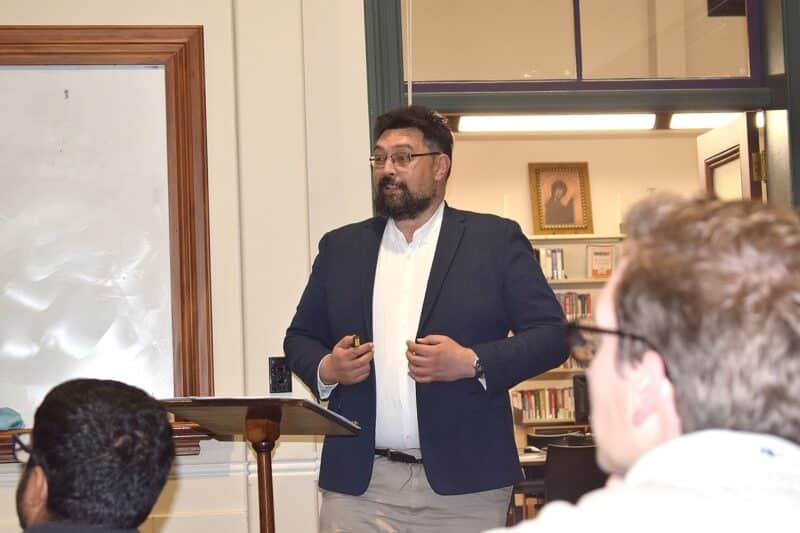
That was the difficult question addressed by Society of Mary seminarian Hemi Ropata, SM, at an Auckland Catholic Young Adults Community gathering in Ponsonby on July 3.
At the start of his address, Br Ropata noted that the inspiration for his talk came from “a lecture that I received from Fr Paul Murray, OP, from Ireland, who teaches spiritual theology at the Angelicum”. Br Ropata, who has just finished his sixth year of seminary training, is currently studying at
the Pontifical University of St Thomas Aquinas in Rome. He was back in Auckland for a break and some pastoral work.
“Let’s talk about scandal,” Br Ropata said, as he introduced his topic. He set out quotes from Church leaders from the 21st century to the 1st century, from Cardinal Ratzinger to St Paul, demonstrating that “the Church has always been in scandal. From the very beginning, there has always been the good and the bad”.
But turning to the modern abuse crisis, Br Ropata admitted that “we feel that this current scandal is somehow worse — it might be true”.
He showed the statistics for abuse in the New Zealand Catholic Church that were sent to the Royal Commission on Abuse in Care — a total of 1680 reports of abuse were made by 1122 individuals against Catholic clergy, brothers, nuns, sisters and lay people from 1950 to the present, with 592 alleged abusers named.
Br Ropata admitted that he had thought a lot about whether he should show these figures or not.
“I came to realise that I had to. We have to confront this as a Church, as priests, and religious and lay people. Everybody has to be aware of it
. . . . And you do what you need to do about it.”
He said that people with whom he speaks are generally supportive of his wanting to be a priest.
“But there is this question that kind of hangs in the air,” Br Ropata said. “The fact is no one has ever asked it [of me]. How do you want to join a group that is a capable of doing terrible, horrible, horrific, unspeakable things, and who are willing to try to hide it?
“It is a valid question, and I don’t really have an answer for it,” he said. But the very best response to this was expressed by Carlo Caretto, who is Br Ropata’s favourite spiritual writer, because Caretto is not afraid of the messiness of human life.
Caretto wrote in “The God Who Comes”: “How baffling you are, oh Church, and yet how I love you. How you have made me suffer, and yet how much I owe you. I should like to see you destroyed, and yet I need your presence. You have given me so much scandal, and yet you have made me understand sanctity. I have seen nothing in the world more devoted to obscurity, more compromised, more false, and I have touched nothing more pure, more generous, more beautiful. How often I have wanted to shut the doors of my soul in your face, and how often I have prayed to die in the safety of your arms. No, I cannot free myself from you, because I am you, although not completely. And where should I go? To build myself another Church? But I could build one only with the same defects, because they are mine, defects which I have inside myself. And if I build one, it would be my church, no longer the Church of Christ.”
This echoes St Peter’s response to Christ in John 6:68, Br Ropata noted. “Lord, to whom would we go? You have the words of eternal life.”
Answer
“This is the answer to the question — why do we remain in the Church? It is the Church of Christ, the Church of the sacraments, the Church of the saints,” Br Ropata said.
The second half of his talk explored this topic, illustrated with quotes from T.S. Eliot, Flannery O’Connor and J.R.R. Tolkein.
A key point, Br Ropata said, is the capacity of the Catholic intellectual tradition to hold together two seemingly opposed concepts. The writing of Bishop Robert Barron was noted — that the Church celebrates a “union of contraries” — for example, grace/nature and body/soul. They are correct by themselves, and they are correct together at the same time.
Br Ropata reflected on passages from the Song of Songs, in which perceived fault and hesitancy is met with poetic reassurance of spousal love.
“This is how God sees the Church as well,” Br Ropata said. “At no point does God ever deny that the Church has done horrible, evil, wicked, unspeakable things. He acknowledges that. But he also says, thou are beautiful.
“That’s why it is so important to be able to sit and have a ‘both/and’ mentality.”
Referring to his own spiritual journey, Br Ropata spoke of the thirst of the soul for the fountain of holiness, which is God. He cited St John of the Cross writing lyrically about the desire of the soul, unfulfilled longing, and the reception of the sacraments. And the sacraments are provided by the Church.
And another compelling reason to stay in the Church is the saints, Br Ropata added.
“The saints always point to Christ. . . . There are the great saints in heaven, but there are also the saints here on earth. You have got people here in our Church who point to God, by their lives, by what they do, by the way they do it.”
The saints have a deep joy, Br Ropata said, and he asked his audience — what does a joyful Church look like?
“People are not always happy all the time, but they are joyful. There is a joy in the Church, and that is what we need to hold on to.”
In conclusion, Br Ropata said: “The Church has always been in scandal, and probably always will. The Church is beautiful and holy, and is the instrument through which we receive the source of holiness. Both are true, both are correct, and both are necessary.
“That is why we remain in the Church. We never deny the fact that the Church has been horribly disfigured by the actions of a minority, [and] that the Church herself has been damaged by that, and the people involved have been damaged by that, and we acknowledge that, and we do what we can do about that.
“But, also, the Church is beautiful, and it is the source from which we receive all that is good.”
Photo: Br Hemi Ropata, SM.


Reader Interactions