Evidence submitted and testimony given by Catholic Church leaders to the second phase of the Royal Commission into Abuse in Care hearing on redress was wide-ranging and touched on many issues. These included responses to complainants, actions taken with regard to those complained of — in terms of disciplinary processes and longterm responsibility for them — as well as safeguarding to ensure future safety within the Church.
Improvements might have been made since the mid-1980s on several fronts, but, as the synopsis of oral closing submissions made on behalf of the New Zealand bishops and congregational leaders stated, it was acknowledged that “there have been — and remain — significant barriers to redress within the Catholic Church”.
“It has been acknowledged by the Pope and Church leaders in Aotearoa that clericalism creates barriers to accessing redress and healing,” the synopsis stated.
This topic was discussed at the hearing in late March, notably by US canon lawyer Dr Thomas Doyle.
During the hearing, Cardinal John Dew agreed with Dr Doyle that clericalism is “a systemic issue within the global Church. It is true here in Aotearoa New Zealand”, the synopsis stated.
“To borrow a phrase from the leaders of the Salvation Army during
this hearing, the Catholic Church’s leaders in New Zealand are not going to ‘duck and weave’ those issues — they can be, and should be, further explored as part of the wider investigation into the Catholic Church [by the royal commission].”
In his apology given to survivors and victims on March 25, Cardinal Dew stated that “. . . . any kind of abuse is unacceptable and indefensible. We are deeply sorry. We acknowledge that the systems and culture of the Church allowed abuse to occur. These systems and culture failed you and must change”.
Questioned about clericalism at the hearing on March 25, Cardinal Dew spoke of a widely-reported request he had once made suggesting people not address priests in Wellington archdiocese as “Father”. The cardinal acknowledged that calling priests “Father” was seen by many as a sign of respect, but he also referenced a French priest who wrote about this and linked it to priests being put above others, and to training of priests in the past to “be almost superior”.
Cardinal Dew said that Pope Francis “says the only authority we have is the authority of service. So our authority doesn’t come from the fact that we normally wear a collar — some of us — or that we have a title or we have a particular role, the Gospel calls us to be of service”.
Cardinal Dew later said that “. . . if we’re not about that and training people in our seminaries to walk with people and be with people, we will always end up with clericalism, but we don’t want people who think they’re better, just because of their title or their particular role in the Church”.
“It is, our ministry today is always about working with others, journeying with others, accompanying one another.”
Culture
Under questioning by counsel, Cardinal Dew spoke of certain cultural factors which can play into clericalism, making it more difficult for abuse to be disclosed.
“It’s a very difficult topic I find with Pasifika families,” Cardinal Dew said, “because often sexuality is not mentioned or spoken about, and there’s the added complexity of the culture of the Church where they don’t want to speak about anything to do with sexuality and they want to keep the Church, and especially clergy, at a level that’s not real . . . “.
At this point, counsel assisting the royal commission Katherine Anderson said “We see clericalism in action in that community, don’t we?”
Cardinal Dew responded: “Absolutely, yes, yes.”
Ms Anderson asking if “an active programme of engagement with the relevant diverse communities that you have would be an essential part of that cultural shift to enable people to come forward?” and Cardinal Dew agreed it would be.
The cardinal elaborated on his answer by stating that “it’s not just the Pasifika community, as people will know, we have very large numbers of Filipinos, very large numbers of Indians these days, Iraqis, you know, all of those communities need to be involved somehow. So there does need to be a reaching out in some way, absolutely”.
Cardinal Dew said there was work going on with the Samoan community in the Archdiocese of Wellington, “again, I acknowledge that more needs to be done”. .
The synopsis mentioned above stated: “There are significant Māori and Pasifika Catholic communities, and Cardinal John acknowledged in his evidence that more should be done to engage with them.” “Cardinal John committed to placing an agenda item on the timetable for the next NZCBC meeting to discuss how the Church can do better for Māori survivors, as a first step to explore this further.”
The synopsis also noted that, based on testimony at the survivor hearing last year, “a substantial proposal document has been prepared by Te Ropu Tautoko (the body set up by the bishops and congregational leaders to liaise with the royal commission) that reflects on the key issues and identifies areas for immediate change and improvement, while also looking forward to the inquiry’s recommendations. Immediately following the conclusion of today’s hearing, the paper will be circulated with the intention it is reviewed by the bishops, congrega
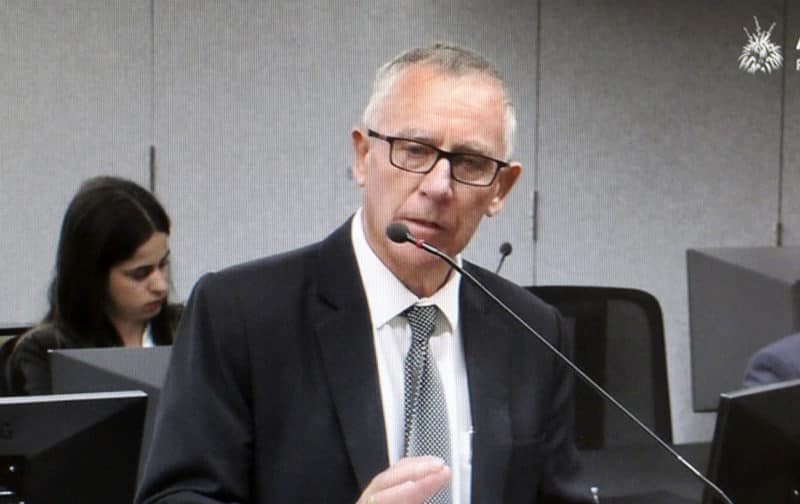
A screen shot of Cardinal John Dew speaking at the royal commission hearing. The wearing of religious attire was not permitted by the royal commission, because of the potential impact on survivors.
tional leaders and other advisors”.
At the end of Cardinal Dew’s time at the royal commission hearing, chair Judge Coral Shaw expressed her appreciation for the fact that the Catholic Church in Aotearoa New Zealand had, in its evidence and testimonies, not hidden behind legal formalities.
“And that commitment to transparency, as I say, is appreciated and goes a long way towards informing our work, and for that I’m very grateful,” she said.
Bishop Drennan
In evidence submitted and testimony given to the royal commission, Cardinal Dew outlined the process followed in the case of the now-resigned Palmerston North Bishop Charles Drennan.
After the bishop’s resignation, the Vatican imposed conditions on him. A letter to this effect from the prefect of the Congregation for the Evangelisation of Peoples, Cardinal Luis Antonio Tagle, was received
by Cardinal Dew in September last year.
“The Vatican imposed the following conditions on Charles Drennan. He was to move out of the diocese of Palmerston North and find accommodation outside the diocese. He is not to participate in any public ministry whatsoever. He is not to wear any episcopal attire or symbols, nor to participate in any celebration or function as a bishop. If he wishes to leave the country, he is to inform, in advance, the Apostolic Nuncio in the country [he] wishes to visit [of] the details of the eventual visit and to abide by his instructions,” Cardinal Dew told the inquiry.
Asked by counsel why Bishop Drennan remained a bishop, Cardinal Dew responded that “that is entirely Rome’s decision. The Pope is the only one who can remove a bishop from office. They have all the information that we have sent through that are referred to. So I really don’t know why he is still a bishop. I can’t say”.
Cardinal Dew added that Palmerston North diocese is continuing to fund Bishop Drennan in the present moment, as it had done previously, and that this was stipulated by Rome.
Orders
Evidence was submitted to the royal commission by the Marist Brothers and by the Society of Mary. Br Peter Horide, FMS, and Fr Tim Duckworth, SM, represented their organisations at the hearing in late March.
In his evidence, Br Horide said that, for those abused by the brothers, “the terrible truth is that you were deeply hurt and the harm will never be forgotten. For your suffering, your memories, and the consequences this abuse had in your lives, I apologise and I am sorry”.
Fr Duckworth was asked why the Society of Mary had not included an apology in their evidence, as others had. He explained that he is grateful to Cardinal Dew for apologising on behalf of the entire Catholic Church, including the Society of Mary, and while he [Fr Duckworth) did not wish to take away from anyone else’s apology, for him, apologies have to be made face-to-face.
“. . . [A]ll of my apologies and all of the apologies that I have seen made from the Society of Mary have all been face-to-face with somebody.” These remarks were received with applause at the hearing.
Fr Duckworth explained that the Society of Mary has 81 disclosures of abuse on its files. Asked why 23 of these are classified as being abuse of adults, Fr Duckworth said that, while he could not be certain, anecdotally he believes some of the adults abused were religious women, which he described as “terrible” and “repugnant”, as it is likewise when a child is involved. Br Horide indicated there were some 57 cases of abuse for which the Marist Brothers had made ex-gratia payments from the mid-1990s to the present day.
The royal commission was told that preliminary data indicated there were 1119 complaints of some form of abuse made to Catholic Church authorities in this country between 1950 and 2020. Numbers available online indicate that the number for Wellington archdiocese is 177 (with Christchurch diocese slightly higher than this), Auckland diocese 171, Hamilton diocese 58, Palmerston North diocese 19. Dunedin diocese was not mentioned in the transcript in this regard.

Why not eliminate the title of Cardinal, too?
The statement that systems and culture must change is quite correct.
Cardinal Martini’s last interview before he died made that clear.
Too many individuals have dropped out of the commitment to the priesthood since Vatican II, which is indicative of something as categorically wrong.
Yet since Medjugorje has begun (and the 40,000,000 plus pilgrims there show this as a distinctive movement), there has been over 500
priestly vocations and many towards the religious life. Surely this must say something to both seminaries, vocations directors, and also
to various Bishops.
One of the chief systems referred to is the methodology employed in priestly formation. The key for all priests should be their personal salvation,
and this means priestly sanctity. If priests seek the glory of God first in their lives their personal salvation must accompany it. That means faithful will benefit.
Two Sacraments that only a priest can perform are generally ignored by most Catholics, Confession/ Reconciliation, and Eucharist.
The Cure of Ars known as the patron saint of the priesthood had an enormous following with his confessions. How many Catholics undertake to go
to confession today? According to Fr Hebert SM, ‘The devil once admitted to the saintly Cure of Ars “If there were three such priests as you in the world, my
kingdom would be destroyed.” ‘
What is the Catholic attitude towards Eucharist? What is the attitude of youth towards the Eucharist? How many Catholics are aware of the miracles of the Eucharist?
How many catholic educators are aware of the miracles of the Eucharist? How many seminaries conduct discussions on the subject of miracles of the Eucharist?
And what does the Catholic catechism say on the subject of miracles of the Eucharist?
Catholic culture is a much-bandied term often misused to describe an Irish sensibility, rather than the sense of universality. It is also accompanied by certain “traits”
which non-Catholics recognise, such as the sign of the cross, and various symbols, gestures, etc; but its essence should be so strong that all people become attracted to it,
rather than turn away. Charismatic prayer meetings when they began certainly attracted a following, even though they appeared on some other day instead of Sunday,
and were in fact non-obligatory. A good u-tube gathering is “Catholic Catholics pray over Pope Francis” (50,000 at the one time).
The MYSTICAL body of Christ is a term not fully understood, and rarely referred to, but it should be, as it is a basic reality of a personal Jesus in everyone’s life. Saint Elizabeth
of the Trinity discusses the importance of baptism and how the Trinity becomes an indwelling God in every person. Eucharist and Reconciliation go hand in hand as vital
aspects of the life of devout Catholics who comprise an important segment of the mystical body of Christ.
In his book, “The Three Ages of the interior life” Fr Reginal Garrigou Lagrange OP discusses the growth of the ardent Catholic through recognisable stages, all of which take
the devout Catholic to a deep level of prayer. There is no reason why these essentials could not be incorporated into high school curricular. It would provide an enrichment
that would hold teenagers closer to the faith, and establish inertia which gives school leavers a positive insight into life in a troubling world.
Before Harry Potter arrived, “The Imitation of Christ” by St Thomas A’Kempis stood second only to the bible in published works.
Is there a hunger?
Ask the author JKRowling who has become a Billionaire since (second richest author in the world).
Yes, Culture must change, and ASAP. Less mobile phone/TV/internet. More fasting, prayer.
When that happens systems will change also.
The Cardinal is apologising on behalf of the Church. Why then is he not attired appropriately? Instead he is wearing secular attire…
The royal commission did not allow the wearing of clerical dress at its hearings as it could be disturbing for survivors.