
Ecumenism could be the Christian response to secularism in New Zealand and the world that would spark an awakening of a desire for God against the numbness that has permeated society.
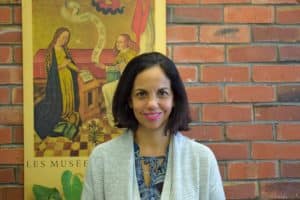
Dr Rocio Figueroa
This was proposed by theologian Dr Rocio Figueroa at a public lecture given at the Pompallier Diocesan Centre in Ponsonby, Auckland, on February 23. The lecture was part of a series of talks sponsored by the Catholic Diocese of Auckland Commission for Ecumenism in celebration of the 25th anniversary of St John Paul II’s encyclical Ut Unum Sint — That They May Be One.
Dr Figueroa, a lecturer at Te Kupenga-Catholic Theological College, said Christians of whatever denomination or faith tradition have one mission: to spread the Good News.
“We have two million around us, in our schools, work and families, who have no faith. Their lives have no transcendental vision,” she said. “We have now a situation in which people can have no reference to God, and feel that they are satisfied, that they are happy, and they feel they don’t need religion.”
Quoting Charles Taylor, author of A Secular Age, Dr Figueroa said we cannot blame secularism on modernity, technology or even science.
“What has happened in our world is the lack of sensitivity towards the spiritual dimension, towards God. So, it’s the lack of imagination, he says. To be a believer, you need to imagine, you need to use symbols. To believe in Christ, we need to think of ourselves as holy persons,” she said.
“That [thinking ourselves as holy] would take lots of imagination,” she quipped.
She said that, in a materialistic society, people are unable to touch their innermost selves, that thirst for God.
“So, really, our work as Christians, and that is why I think ecumenism is really an answer for our times, . . . [is to] spark an awakening of that desire for God, because people are numb,” she said.
Coming from Peru, where 98 per cent of the people are Catholics, Dr Figueroa said she had a culture shock meeting people in New Zealand who were accepting of the idea that there is no afterlife.
However, she said, it has made her so happy to meet and work with Christians of different faith traditions, but who, basically, share her faith in Jesus.
“Here in New Zealand, I feel incredibly connected [to other Christians],” she said.
She has been working with theologians from the Anglican, Presbyterian, Protestant and Evangelical churches. “We united for one cause,” she said.
Dr Figueroa also said ecumenism and multiculturalism come hand in hand. She said theologian John Mackay aptly noted “both ecumenism and multi-culturality underline the diversity within the unity of the Church. Both point to the nature of Catholicity”.
There is a challenge here, Dr Figueroa said. “We have the challenge . . . to create a Church that is open to the different cultures, and does not isolate the communities.”
Dr Figueroa said that, in Evangelii Gaudium, Pope Francis outlined his model of ecumenism, the polyhedron.
In this document, the Pope explained the polyhedron “reflects the convergence of all its parts, each of which preserves its distinctiveness. Pastoral and political activity alike seek to gather in this polyhedron the best of each”.
“I think this is much more flexible,” Dr Figueroa reflected. “It is a vision that brings a little bit of hope [for] how we can understand unity. Because unity is not uniformity.”
“We can have different visions, different traditions, different approaches, but there is something that is the essence, that is the beautiful diamond, that we have in common: the belief in Jesus Christ as the Saviour. That’s the most important thing.”

Ecumenism is fine provided non-Catholics are willing to accept the Catholic view of the REAL PRESENCE.
There are over a hundred miracles of the Eucharist for those who are willing to go looking, but remarkably
the Catholic staff of Catholic schools are not always aware of such things.
They should be.
One of the reasons is that the Catholic catechism does not promote such material but instead promotes another agenda.
So the “Protestants” get blamed for a “Protestant influence” in Catholic churches, and ecumenism is useful as a tool for diffusing various
disagreements.
The other factor is clearly outlined in “Trojan horse in the city of God” by Dietrich Von Hildebrand, the individual
he named as the “progressive Catholic” who is not only wrong and has no interest in the supernatural (e.g. Fr Pierre Teilhard de Chardin
for instance) but actually gets in the way of sanctification of souls for this perverse view. Hildebrand is recognised as a leading ethicist
whose comment resulted in his being sentenced to death in absentia by the Nazis. He was recognized by both Pope Benedict XVI and Pope Saint5 John Paul II.
Evangelical Anglicans can do much by investigating the history of Catholicism in the UK, and the notion of the “dowry of Mary”
recently celebrated which takes the UK to a time before Henry VIII. That could easily be an assignment topic for Catholic (and Anglican) school children
who would glean much from a study of history, and the difference between Anglican Communion and their own.
The Catholic Catechism does not cost that much, but it is worth infinitely more than any Harry Potter novel.
Every Catholic home would wisely draw attention to it when tapping into controversial topics that engage Ecumenism.
Ecumenism does not make catholicism any more right than it already is. It merely opens the door for non-Catholics to engage
in a fruitful discussion in which Catholics can demonstrate wh6y Catholicism is so much better than Anglican Communion,
and the reason is the REAL PRESENCE.