





By Francis X. Rocca
VATICAN CITY (CNS) — In official reports of the closed-door talks at the Synod of Bishops on the family, an emerging theme has been the call for a new kind of language more appropriate for pastoral care today.
“Language appeared many, many times,” Basilian Father Thomas Rosica, the briefer for English-speaking journalists, told reporters Oct.7, the assembly’s second working day. “There’s a great desire that our language has to change in order to meet the very complex situations” the church faces.
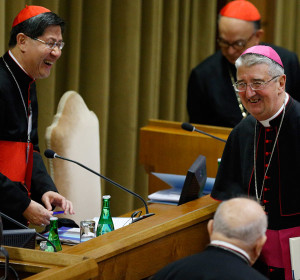
One bishop, whom Father Rosica did not name in accordance with synod rules, reportedly told fellow participants that “language such as ‘living in sin,’ ‘intrinsically disordered’ or ‘contraceptive mentality’ are not necessarily words that invite people to draw closer to Christ and the church.” (“Intrinsically disordered” is a term used by the Catechism of the Catholic Church to describe homosexual acts.)
Speaking to the synod Oct. 7, Archbishop Diarmuid Martin of Dublin spoke of the need for new language with which to communicate with married couples.
“To many, the language of the church appears to be a disincarnated language of telling people what to do, a one-way dialogue,” the archbishop said, according to excerpts of his remarks published by the Irish bishops’ conference. “The lived experience and struggle of spouses can help find more effective ways of expression of the fundamental elements of church teaching.”
Following the same session, Cardinal Wilfrid Fox Napier of Durban, South Africa, told Catholic News Service that “language is something we’ve overlooked for a good while; we’ve used language that is out of touch with the way people speak today.”
“In the past, it was sufficient to say to people, ‘You are going to hell if you continue this way of life.’ Hell was a reality and it was something they knew and they understood it. But if you talk about hell today, people don’t know what you are talking about,” Cardinal Napier said. “So I think the emphasis is shifting (toward), ‘how can you be in a loving relationship with Jesus, and through Jesus with your brother and sister in the church, if you are living in this condition which separates and alienates you from Jesus?”
German Cardinal Walter Kasper, whose controversial proposal to make it easier for divorced and civilly remarried Catholics to receive Communion has been a major topic of discussion at the synod, told CNS Oct. 1 that a traditional description of such couples as practicing “perpetual adultery” is not acceptable in a pastoral context.
“If you tell people who live in this way and they do it in a responsible way, tell them that adultery, permanent adultery, I think they would feel insulted and offended. We must be very careful also in our language,” Cardinal Kasper said in English. “Permanent adultery? It seems to me too strong.”
Bishop Johann Bonny of Antwerp, Belgium, is not a member of the synod, but in September he published a widely read essay calling on the assembly to initiate a range of major changes in the church, including in its language, which he argued is often “offensive” and “humiliating.”
Couples living together outside of marriage, using contraception or resorting to in vitro fertilization — all activities prohibited by Catholic moral teaching — “deserve more respect and a more nuanced evaluation than the language of certain church documents appears to prescribe. The mechanisms of accusation and exclusion they have the potential to activate can only block the way to evangelization,” Bishop Bonny wrote.
The synod heard an example of newer language Oct. 6, when two non-voting auditors told Pope Francis and the rest of the assembly that Catholic parishes should welcome same-sex couples.
In their remarks, Ron and Mavis Pirola used the word “gay,” rather than “homosexual person,” which has been the preferred term in official Vatican discourse. The Pirolas may have taken their cue from the pope, who famously used the word “gay” during an inflight news conference in July 2013.
The Pirolas also said much of the church’s teaching is expressed in language that seems to be from “another planet” and “not terribly relevant to our own experiences.”
Not all synod fathers have the same idea of what language the church should adopt or discard.
In remarks to the assembly Oct. 9, Cardinal Andre Vingt-Trois of Paris, one of three synod presidents appointed by the pope, denounced the “contraceptive mentality” he said leads many Catholics to think the use of artificial birth control is not a sin.
Later that day, Cardinal Vingt-Trois told CNS that, although the church must “find modes of expression and modes of communication that will allow it to announce the good news so that it may be heard,” changing pastoral language does not mean changing the language in which theologians formulate church teaching.
“When a physician makes a diagnosis, he uses terms to designate precisely the disease in question, but these terms, if he tells them to the patient, he will not understand them. Therefore, he must explain the diagnosis with words that are not technical words. In theology, it is the same thing,” Cardinal Vingt-Trois said.
“When one addresses people to announce the good news of Christ, one does not teach a theology course. One tells them the contents of the theology but with a vocabulary they can understand,” the cardinal said. “I was a professor of theology. When I taught a theology course, I did not give a sermon; that is another literary genre.”
END






“If you tell people who live in this way and they do it in a responsible way, tell them that adultery, permanent adultery, I think they would feel insulted and offended. We must be very careful also in our language,” Cardinal Kasper said in English. – Living in an adulterous relationship “in a responsible way”? How can you responsibly break your marriage vows and live opposite to God’s laws in a responsible way? Can this thinking be also applied to other sins? Responsibly committing murder, theft, peadophilia, gluttony, lying? Yes you be gentle with people when you are trying to correct them, or telling them their way of life is wrong etc. However to not explain to them it that what they are doing is sinful, that they are offending God, that they are harming each other – this is being dishonest to them. When I wasn’t living a good life, it was actually a Priest who (charitably and nicely) told me what I was doing wrong and explained to me what I was doing was offending God and was sinful. It was that, that made me want to change my life. And knowing that if I died in the state of Mortal Sin I would spend eternity in Hell is what made me amend my life. So those who are honest and want to strive for goodness actually do want to hear the “hard truths”. Those that don’t want to hear that they are doing wrong just want to live in their imaginary world where everything goes and God can’t tell us what to do.
Truth is eternal. There is one Truth. Truth is not democratic. Yes, God is Love, but God is also Truth.
This dialogue to use accomodating language to tease those who are offended by the harder words of Truth into the pews is troubling. As we look to alter language to accomodate the immature “faithful”, we will simultaneously confuse the whole world.
Language is the pathway into the conscious thoughts of man. Our souls may respond to different stimuli, but our thoughts are formed and expressed in language. Intentionally introducing language of uncertainty, albeit for a good reason, seems only destined toward a bad end.