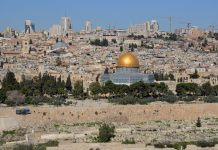


JERUSALEM (CNS) Pope Benedict XVI took his Holy Land pilgrimage from Jordan to Jerusalem, where he pleaded for peace among Israelis and Palestinians, condemned anti-Semitism and prayed at a Holocaust memorial. The pope’s first day in Jerusalem May 11 was a busy one, and it began with a remembrance of Jewish suffering under the Nazi extermination campaign and a strongly worded warning about new forms of anti-Semitism.
Speaking at a welcoming ceremony at Ben Gurion International Airport in Tel Aviv, the pope said he had come to honor the memory of the 6 million Jewish victims of the Holocaust and "to pray that humanity will never again witness a crime of such magnitude."
"Sadly, anti-Semitism continues to rear its ugly head in many parts of the world. This is totally unacceptable. Every effort must be made to combat anti-Semitism wherever it is found and to promote respect and esteem for the members of every people, tribe, language and nation across the globe," he said.
As Israeli President Shimon Peres and Israeli government leaders listened, the pope then urged a negotiated peace settlement that will allow Israelis and Palestinians to "live in peace in a homeland of their own, within secure and internationally recognized borders."
The pope’s words represented a tacit endorsement of the two-state solution, which foresees the establishment of an independent Palestinian state. The recent political realignment in Israel has thrown into doubt Israel’s openness to Palestinian statehood.
The 82-year-old pontiff looked tanned and fit as he delivered his speech in English on a platform adorned with Vatican and Israeli flags.
Meeting with Peres at the presidential palace in Jerusalem the same day, the pope spoke about the sensitive topic of security, saying the term needs to be understood in a scriptural perspective of trust, and not simply "the absence of threat."
"Security, integrity, justice and peace. In God’s design for the world, these are inseparable," he said.
The pope added that basic values and rights in society are universal and cannot be conditioned by particular interests.
"A nation’s true interest is always served by the pursuit of justice for all," he said.
In a moving visit to the Yad Vashem Holocaust memorial, Pope Benedict prayed silently before the eternal flame in the Hall of Remembrance and said the suffering of Jews under the Nazi extermination campaign must "never be denied, belittled or forgotten."
The pope called the Holocaust an atrocity that disgraced mankind and said the church is committed to working tirelessly "to ensure that hatred will never reign in the hearts of men again."
"May the names of these victims never perish! May their suffering never be denied, belittled or forgotten! And may all people of good will remain vigilant in rooting out from the heart of man anything that could lead to tragedies such as this!" he said.
His visit to the memorial came after a period of Catholic-Jewish tension, following the pope’s lifting of the excommunication of a traditionalist bishop who minimized the extent of the Holocaust.
In the evening, the pope addressed a group of interreligious dialogue experts and said the common witness of God’s place in the world by all religions is essential in a world that has in some ways become "deaf to the divine."
The pope began his eight-day trip in Jordan, where he walked a pilgrim’s path, energizing its minority Christian population and building bridges to the moderate Muslim world.
Arriving at Amman’s airport May 8 he said he had come as a Christian pilgrim and with "deep respect" for the Muslim community. It was Pope Benedict’s first trip to an Arab country.
As King Abdullah II stood at his side, the pope commended Jordan for curbing extremism, protecting religious liberty and promoting "a better understanding of the virtues proclaimed by Islam."
He paid special tribute to interfaith dialogue initiatives launched by Jordanian leaders, saying they have advanced an "alliance of civilizations between the West and the Muslim world, confounding the predictions of those who consider violence and conflict inevitable."
The pope’s first stop in Amman was the Regina Pacis center, a church-run facility for the disabled, and it underscored the charitable role played by Jordan’s minority Christian population in cooperation with Muslims. Arriving to loud cheers, he waded into a huge crowd of well-wishers as a band played the "gerpe" — a Jordanian bagpipe — and tabla, or hand drums.
The following day, the pope visited the King Hussein Mosque in Amman, pausing briefly in what the Vatican called "respectful meditation" in a Muslim place of prayer.
In a speech afterward to Muslim academics and religious leaders, the pope underlined the common belief in God shared by Muslims and Christians, but also warned of the "ideological manipulation of religion" that can act as a catalyst for tensions and violence in contemporary societies.
The pope traveled May 9 to Mount Nebo, the place where Moses glimpsed the Promised Land before dying. From a windswept promontory, he looked out over a biblical panorama that stretched from the Dead Sea to Jericho across the Jordan River, with the hills of Jerusalem in the distance.
He then rode his popemobile to the ancient biblical city of Madaba. As he passed slowly along the dusty streets of the city’s Christian quarter, he was cheered by thousands of people who held flags, signs and photos of him.
There he blessed the foundation stone of the University of Madaba, the first Catholic university in Jordan, and affirmed that belief in God does not suppress the search for truth — although he added that religion, like science and technology, can be "corrupted" when pressed into the service of ignorance, prejudice or violence.
That evening, the pope received a tumultuous welcome at the Melkite Catholic Cathedral of St. George in Amman, where he encouraged the country’s Catholic minority to make its voice heard in public life and to join forces with Muslims when moral concerns cross religious boundaries.
The pope’s Mass May 10 in an Amman soccer stadium that holds 25,000 people was the liturgical high point of his visit. In his homily, the pope preached as a simple pastor, recognizing the spiritual and material struggle of Christian families in the land where the church was born.
Christians in the Holy Land have a special vocation to engage in dialogue and build new bridges to other religions and cultures and to bear witness to the sacrificial love of Christ "and thus counter ways of thinking which justify taking innocent lives," he said.
Later in the day the pope made his way to the Jordan River, where archaeologists believe they have identified the site of Jesus’ baptism by St. John the Baptist. He blessed the foundation stones of two Catholic churches — one Latin-rite and the other Melkite — to be built at the location and said the new construction was a hopeful sign for a Christian community that goes back to the church’s beginnings.