


by MICHAEL OTTO
AUCKLAND — When asked to name the two top qualities needed to make a good rugby league coach, famed former Australian national team coach Wayne Bennett gave an Auckland audience an answer they may not have expected.
Bennett, known for his cool demeanour during matches and for his no-nonsense approach in general, told people at the Otahuhu Rugby League Club’s rooms on July 20 that first “you have to care about people”.
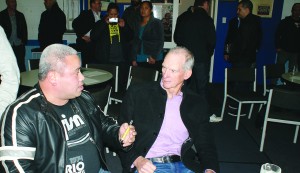
Wayne Bennett, right, discusses rugby league and other matters with a patron at the Otahuhu Rugby League Club.
“I think that is really important. [Then] you have to be someone people can trust.
“After that, you don’t have to be the best coach in the world, but it makes you a pretty decent bloke.”
Bennett, an icon of the game, with teams he coached winning seven NRL premierships and several State of Origin series, was in town with his Newcastle Knights team to play the Warriors.
The night before the game, he was a guest speaker at Otahuhu at a fundraiser for the Edmund Rice Camps Auckland charity, which has grown out of the ministry of the Christian Brothers.
The camps provide one-on-one mentoring for young people who have been disadvantaged socially, financially or in some other way.
Bennett, whose role as assistant coach and adviser to the New Zealand Kiwi team was pivotal in their 2008 Rugby League World Cup success over Australia, had been asked to help out at the fundraiser by a Christian Brother and a personal friend, Br Damian PrIce.
The former Canberra, Brisbane Broncos, St George-Illawarra and Queensland coach spoke about how his own life could easily have gone off the rails had it not been for the influence of a young Christian Brother at a school in Warwick, Queensland.
Coming from a broken home — his father abandoned his family when the young Wayne Bennett was aged about 11 — he wasn’t very interested in school.
“I didn’t give a #$%! to be honest. I didn’t want to be there most days. I conned my mother most days as to why I shouldn’t be there,” Bennett said. He eventually left school in year 8 to try to earn a living.
But it was during his school days that he came across the man he calls “one of the greatest influences in my life”, Christian Brother Mick Bible.
“So this young Christian brother turns up, and the first thing I learned from him is that he cares about people. He didn’t care what your mum and dad did, he didn’t care what your background was, he cared about you,” Bennett said.
“Then he set about teaching, setting boundaries, not accepting your second best, not tolerating your second best, and being constant and fair in all times and in all situations.
“And so, as a little boy . . . he had a huge impact on me. And if I like to compare myself with someone today in the way I coach, I like to think I was as good as Br Bible.
“I care about the young men I work with, the importance of being truthful and [for] equality, regardless of their backgrounds, regardless of how good they can play the game. And to give them every opportunity to be the best football player they want to be. . . . And to set boundaries, create an environment where young men can come and find out how good they can be.”
Br Bible is now living in Rockhampton in Queensland, aged in his 70s, Bennett said. The coach expressed his admiration for the work of the brothers.
“I have huge respect for them, because of what they did for so many. They ask nothing in return, but they have given their lives to help young men like me and those who have been part of Christian Brothers schools. And they have changed and chiselled a lot of us into the people that we are.”
A Brisbane Courier Mail feature article in 1999 explained how Bennett gained his “ferocious work ethic” from his mother, who often worked herself to exhaustion to give her children a chance in life. His mother also gave Bennett his Catholic faith, and he has been a regular at Sunday Mass.
n Parenting
After his Otahuhu talk, responding to questions from the audience, Bennett spoke about the importance of good parenting.
“The best thing you can do as a parent is to be a good mum and dad. Because the best kids that we have come out of good homes, where somebody cared enough about them, where they have got some discipline and some [good] attitude and all that. That is the greatest gift you can give them. It makes my job as a teacher much easier. The great battles we had with kids that don’t have a chance, and then they try and make something of their lives, and they start years behind everybody else and sometimes they just can’t catch it up.
“So it is a great responsibility being a parent. Unfortunately, we don’t all accept it.”
But Bennett is very serious about setting boundaries and enforcing them with young players.
“If you want to play rugby league and you want to be successful, there are certain things you ‘ve got to do . . . [but] taking short cuts, having a bad attitude, thinking there is a soft way to win. You are kidding yourself. If you don’t want to pay that price [for success], you are not going to make it in my team anyway. Go and play for somebody else.”
Having ability and wanting to improve are essential for any young player who wants to meet Wayne Bennett’s standards.
“Most young guys who have had a bit of trouble, they can give you a better lecture about their behaviour than you can give them, because they have heard that from [day one]. So I’m not there to give them lectures, just give them boundaries and if they keep breaking the boundaries, then I’ve got to assume they don’t want to be there. That is the choice they are making.”
Bennett’s talk featured a series of amusing anecdotes from around the rugby league world, including his puzzlement at many modern players’ need to have their own name tattooed on their body.
n Sonny Bill
One questioner asked him if he would want double international and current Chiefs player Sonny Bill Williams to play in his Newcastle team. Bennett’s answer was emphatic.
“I’m a Sonny Bill Williams fan, I’m pleased he has come back to the game, but I wouldn’t sign him. He’s terribly distracted.
“You know, I said I worked with him in the Kiwi team and I think he is a wonderful bloke, but you are either committed to one or the other one. You are either committed or you are not. If you want to win a premiership, you want to be that team you want to be, you all have to be on the same page, you cannot compromise, you know, about who is doing what and why someone over there is doing something. It doesn’t work. And, you know, premierships are so hard to win, and everything has to line up, all the stars have to be in line for you, at the time, and if you are in “club land” and you are in club coaching, that’s the pinnacle of what we do — win the premiership. And Sonny Bill has got a lot of distractions around him.”
As for Bennett himself, he said he is “just a coach, trying to do my best”.
In fact, doing your best is at the heart of his coaching philosophy. It sounds like something he might have picked up from Br Bible all those years ago.
“My coaching philosophy is do your best, pretty much. That’s what I expect from [players], whatever your best is, I can work with that. But don’t give your second best. I’m not interested in that.”